
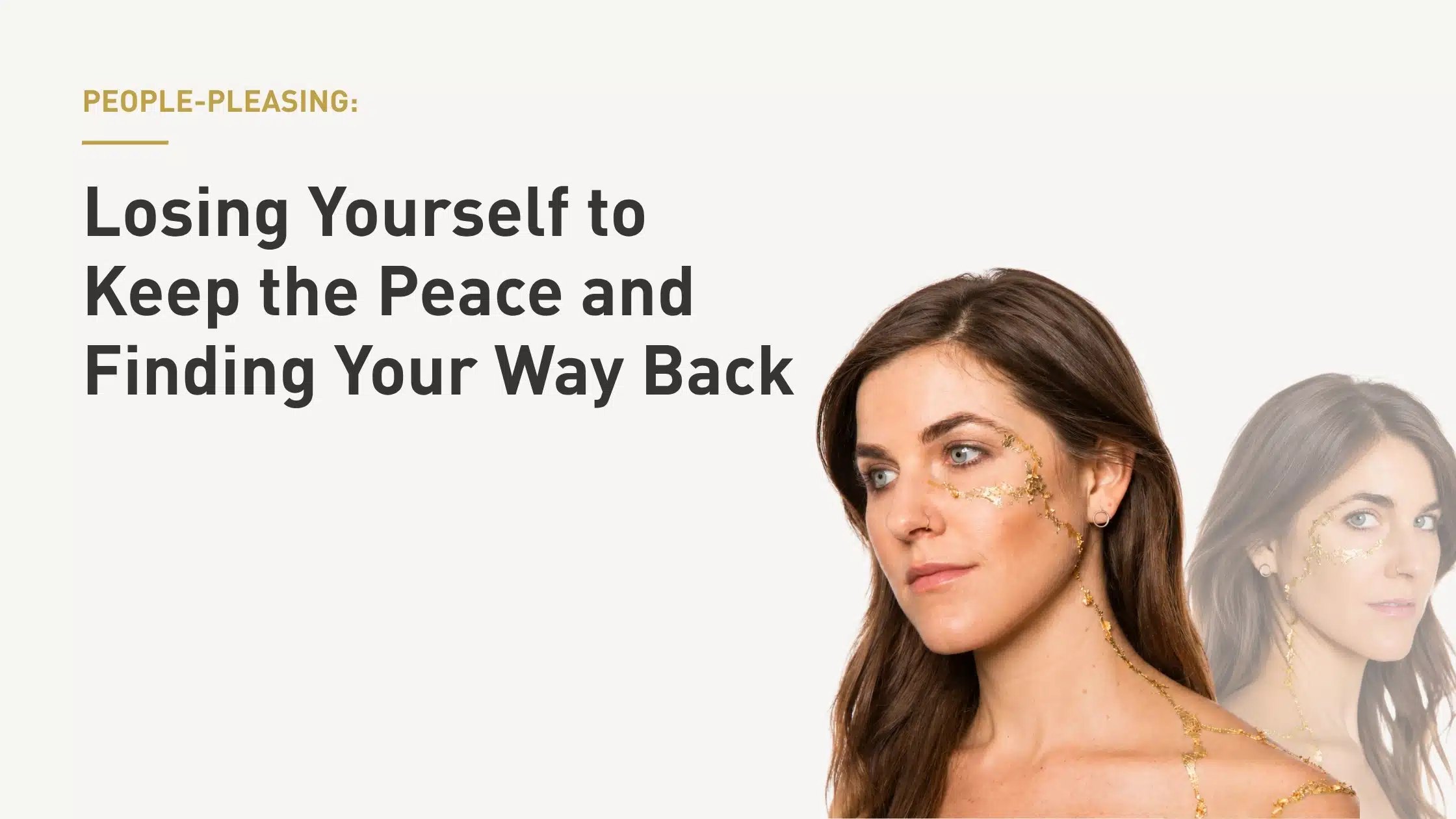
Have you ever said yes when everything inside you was saying no?
Maybe you agreed because you did not want to disappoint someone. Maybe you stayed quiet to avoid conflict, softened what you really thought to keep the peace, or found yourself working harder and harder to make sure everyone else was okay, or so you wouldn't feel guilty or be criticized.
People pleasing is a pattern of prioritizing another person's comfort, needs, feelings, approval, or expectations at the expense of your own well-being. You might say yes when you want to say no, apologize when you have done nothing wrong, hide your opinions, over-explain your choices, or feel responsible for managing other people's emotions and opinions of you.
From the outside, it can look like kindness. But when it is driven by fear, a need for approval, or a desire to stay connected, it can quietly erode your peace, your self-esteem, and eventually your sense of self. If you struggle to set boundaries, find it hard to say no, or feel like you are losing yourself to keep the peace or to feel valued, this is the pattern this article is talking about.
For many people, especially those who have experienced difficult, confusing, unpredictable, or abusive relationships, these people-pleasing tendencies are not necessarily personality traits. They may be learned patterns that once helped you cope with pressure or low self-esteem. In what follows, we look at where people-pleasing comes from, why no feels so difficult, how it connects to survival responses and external validation, what it does to your well-being and relationships, and how to begin setting healthier boundaries so you can return to a more authentic self.
Why People Pleasers Learn to Put Everyone Else First
Sometimes people-pleasing begins because being agreeable once reduced conflict. Maybe you grew up in a home where one person's mood affected everyone else. You learned to notice a change in tone, a facial expression, or a door closing a little too hard. You became alert to what might happen next and learned how to adjust yourself before things escalated.
Love or approval may also have felt conditional. Perhaps you received affection when you were helpful, successful, obedient, or easy to manage, but criticism or withdrawal when you expressed difficult emotions or your own needs. That can happen when caregivers were unavailable emotionally, teaching you that connection had to be earned. People-pleasing tendencies can develop with little self-awareness.
Some people also learn that being a caring person means always being available, always helping, or never disappointing someone. Over time, that can create a strong emotional need to feel useful or needed.
You may begin to feel obligated to solve problems that aren't yours to solve or to take responsibility for others' happiness.
In difficult or abusive relationships, appeasing another person can become even more important. If disagreement leads to rage, blame, withdrawal, intimidation, criticism, or punishment, you may learn to stay calm, give more, ask for less, or carefully choose every word. Later, this pattern can attract emotionally demanding people who take advantage of weak boundaries.
You may think, "If I explain this perfectly, maybe they will understand," or "If I stay agreeable, maybe this will not get worse."
This is one reason people-pleasing behaviors are sometimes connected to the fawn response, a survival response sometimes linked to child sexual abuse, in which a person tries to create safety by appeasing or accommodating someone they perceive as a threat.
Seen through that lens, the behavior makes sense. The problem is that a survival pattern can continue long after it begins costing you more than it protects you.
What People Pleasing Behavior Can Look Like in Everyday Life
You may say yes to plans when you are exhausted, then wonder why you are feeling drained or resentful later. You may apologize before expressing an opinion or soften your words so much that the point disappears. You may volunteer for more than you can handle because disappointing someone feels worse than overextending yourself, or you believe doing so will make people happy and improve how they value you.
People-pleasers tend to become highly aware of other people's reactions. If someone is quiet, irritated, or disappointed, you may immediately wonder what you did wrong and start looking for ways to fix it.
Conflict can feel especially threatening. Rather than risk disagreement, you may change your opinion, stay silent, or tell yourself something "isn't a big deal" even when it is hurting you.
You may also over-apologize, saying "sorry" when you need help, take up space, or when something is completely outside your control. For example, instead of saying "I'm sorry for the delay," you might say "Thank you for waiting." It also helps to remember that not everything is your fault.
Over time, people-pleasing can make it harder to make independent decisions. If you are used to checking what everyone else wants first, it may become hard to know what you prefer without asking for reassurance.
You may look to a partner, family member, or friend to confirm that your decision is acceptable before you trust yourself.
And beneath all of this may be a question that rarely gets spoken aloud:
"Will I still be loved if I stop making everything easier for everyone else?"
That is part of what makes people-pleasing a difficulty to change. Saying no may not feel like a simple decision about your time. Your nervous system may experience it as a threat to connection.
External Validation Versus Genuine Connection
External validation is not inherently bad. Caring what others think is not a bad thing by itself. We all appreciate encouragement and being seen by people we love.
The problem comes when approval becomes necessary for you to value yourself, or feel safe or okay.
This can make people-pleasing look very similar to kindness, but there is an important difference.
Kindness is freely chosen. People-pleasing is often a focus driven by a fear that most people will find fault in you.
With kindness, there is room for both people. You can genuinely want to help someone while also recognizing your own limits. You can say yes because you mean yes. You can say no without believing you have become uncaring or less valued.
People-pleasers are more likely to say, "I will abandon what I need so you will not be upset with me."
That is not the same thing as generosity.
True connection also requires honesty.
A relationship may appear peaceful because one person rarely disagrees, doesn't ask for much, and is constantly aware of how others may perceive them. But if that peace depends on one person disappearing, it is not really peace. It is managed tension.
Healthy connection has room for differences, repair, emotional responsibility, healthy boundaries, and considering the needs of both people, rather than prioritizing other people while losing touch with yourself.
In a healthy relationship, your no may disappoint someone, but it does not threaten the entire connection. You can have a different opinion and still be respected. Your needs are not automatically treated as an inconvenience.
Sometimes becoming more honest reveals that a relationship was only working because one person did most of the adjusting. That realization can be painful, but it can also bring important clarity. Why We Seek External Validation
It is natural to care about what people we love think of us. The problem arises when we begin to desire external validation so consistently that another person's approval determines whether we feel safe, worthy, or okay.
If approval once felt connected to safety or belonging, criticism can feel much bigger than disagreement. Someone else's disappointment may feel like evidence that you have failed or done something wrong or are less than others.
This can make people-pleasing difficult to interrupt because the desire is no longer simply to be helpful. The deeper goal may be to preserve connection, avoid rejection, or reassure yourself that you are still accepted.
Research suggests that experiences involving conditional approval, relational insecurity, or chronic stress can shape how strongly people depend on reassurance and social acceptance. It may have begun with how parents interacted with you in childhood or beyond. But regardless of where the pattern began, healing often involves gradually changing course by looking inward in new and healthy ways. Unless you are intentionally or actively harming people, we all deserve kindness and respect. We are worthy by simply being our authentic selves.
Instead of asking only, "Are they happy with me?" you can begin asking, "Am I being honest with myself?"
Instead of, "Do they approve of this?" you might ask, "Does this choice reflect my values, needs, and capacity?"
The goal is not to stop caring about other people's feelings. It is to stop allowing their approval to become the only measure you use to determine your worth.
How People-Pleasing Affects Self-Esteem and Self-Worth
One of the deepest costs of chronic people-pleasing is that you can slowly lose touch with yourself.
When so much attention is directed toward what other people think about you and want, you may stop asking what you want. Their reactions become your compass. Their approval begins to influence whether you feel good, secure, or worthy.
Over time, this can affect both self-esteem and self-worth because your value becomes tied to what you provide to your partner or others.
You can even feel lonely while surrounded by people because the version of you that is being accepted is not the whole, honest you.
This is where self-awareness becomes critical, especially when low self-esteem keeps the pattern going. Daily self-reflection and writing down your internal thoughts about yourself can help you realize why you believe what you believe about yourself that needs to change course. It can be a difficult process as you gradually gain an awakening about how much you can control your own thinking patterns. It's a true advantage to ponder where your thoughts originated.
You may begin to realize how much of your life has been shaped by others' opinions and how rarely you have paused to ask what is true for you. As a child, you may have been shaped by how your parents were emotionally distant, punitive, or conditional with their approval.
Look back at childhood experiences, and write down what you observe with an adult lens. Self-assuredness, a strong sense of identity, and confidence are attainable.
You may find yourself asking:
"What do I actually think?" "What do I enjoy, apart from other people's expectations or my own desires?" "What feels right to me?" "What feels heavy, uncomfortable, or unsafe?" "Who am I when no one needs anything from me?"
That process can slowly rebuild confidence in your own judgment.
The Negative Consequences of Always Keeping the Peace
The negative consequences of people-pleasing can reach far beyond an overcrowded calendar.
Your body can begin carrying the cost.
You may feel chronically tired, anxious, irritable, numb, resentful, or emotionally shut down, and that kind of chronic stress can wear on your mental health. Decision-making can become difficult because you are so accustomed to asking what others want that your own preference feels unfamiliar.
You may replay conversations, worry that you said the wrong thing, scan for signs someone is upset, or struggle to rest because part of you remains focused on what someone else needs, especially when you doubt your worth or fear you did something wrong.
You may also notice that you are feeling drained even after interactions that looked perfectly pleasant on the outside.
Resentment can build, too.
That resentment does not necessarily mean you are selfish or unkind. It may be information.
Your anger may be telling you that a boundary was crossed.
Your sadness may be telling you that something important has been ignored.
Your anxiety may be telling you that honesty does not feel safe in a particular relationship.
Your exhaustion may be telling you that you have been over-functioning for too long.
Instead of judging those feelings, it can help to get curious about what your inner world has been trying to tell you.
Why People Pleasers Say Yes When They Want to Say No
If you have been people-pleasing for a long time, saying yes can become almost automatic. You may agree before you have even checked in with yourself.
Sometimes the fear underneath is not really about the request itself. It may be about what you imagine will happen if you decline. Will they be disappointed? Will they think you are selfish? Will they pull away? Will they become angry?
That is why learning to pause can be the first step toward responding differently.
Instead of immediately saying yes, try giving yourself time to notice what you actually want and whether you have the capacity to take something on, so you can decide after checking what you have room for and what really does matter to you.
A simple response such as, "Let me think about that and get back to you," can create enough space to make a choice instead of reacting from fear. It gives you time to decide rather than respond automatically.
Over time, that pause can help you recognize the difference between a genuine yes and a yes that comes from anxiety, obligation, or fear of rejection.
Why Saying No Can Feel So Hard
If you have been saying yes for a long time, your no may surprise people who have learned to expect you to adjust, make an exception, or place their comfort above your own.
When that changes, someone may say, "You've changed," "You used to be so helpful," "Why are you making this such a big deal?" or even, "I thought you cared."
That response can be painful, especially if rejection is exactly what you have spent years trying to prevent.
But another person's discomfort does not automatically mean your boundary is wrong. Their reaction is not always your fault.
Repeated patterns create expectations, so a reasonable limit may feel like a dramatic change to someone accustomed to your constant yes, especially if they were disappointed to lose the advantage of your over-accommodation. In reality, your no may be one of the first signs that you are coming back to yourself.
A healthy no is not cruelty. It is clarity.
It gives someone accurate information about your time, energy, capacity, values, and limits.
And something important happens when you become more comfortable saying no: your yes can become honest again.
How to Establish Boundaries and Set Limits Without Abandoning Your Compassion
Learning to establish boundaries and set limits means learning to include yourself in your own care. It does not mean becoming harsh, cold, or uncaring.
Start small.
Practice with lower-stakes situations first.
If you tend to answer requests immediately, give yourself time. Try saying:
"Let me think about that and get back to you."
Then ask yourself a few questions, and sit with the request before answering.
Do I actually want to do this? Do I have the capacity? Am I choosing this from genuine care, or am I afraid of what might happen if I say no? What am I afraid this person will think about me?
This is another place where self-awareness can help. Pay attention to what happens in your body. Sometimes your body notices your limits before your words are ready.
When the answer is no, practice letting it be simple.
"I'm not available for that." "That doesn't work for me." "I care about you, but I'm not able to take that on."
Do not keep making excuses when the answer is no.
People pleasers often over-explain because they want the other person to agree that their boundary is reasonable, so remind yourself that a clear no is enough. But clear boundaries do not require everyone else's approval.
Healthy boundaries can be kind, calm, and direct. Kind people will tell the truth, even if it might hurt the other person. Telling the truth is kind, and it is where people-pleasing stops.
If you give a long explanation, you may unintentionally create an opening for someone else to negotiate your no. You do not always need to convince another person that your reason is good enough. Clear is kind.
It can also help to expand your definition of having plans. For example, rest is a plan. Time with your children, reading, creating, recovering, or doing nothing at all can be a legitimate use of your time.
Can You Stop People Pleasing Without Becoming Selfish?
Many people worry that if they stop people-pleasing, they will become selfish, uncaring, or difficult.
But healing is not about caring less.
It is about caring without disappearing.
You can still be generous. You can still help a friend. You can still notice someone else's feelings and respond with empathy. You can still receive joy from making another person feel good. Caring for others is not wrong unless it consistently comes at the expense of his or her own needs.
The difference is that helping becomes a choice rather than an obligation, not a way to abandon your own needs just to keep others comfortable.
You can care about someone else's happiness without making yourself responsible for creating it.
You can be a caring person and still have clear boundaries.
You can love people deeply and still say, "I cannot do that."
That balance is part of what healthy connection looks like.
Coming Back to Yourself
Healing from people-pleasing is not about becoming a different person. It is about becoming more honest about the person who has been there all along.
It may begin with noticing where you have been performing instead of being present.
Where have you said yes while your body, mind, or spirit was saying no?
Where have you confused approval with safety?
Where have you disconnected from yourself in order to stay connected to someone else?
Approach those questions with compassion rather than shame. The goal is not to criticize what you did to survive, but to recognize when an old strategy is no longer serving you and practice something new.
There may still be guilt when you set a boundary. There may be anxiety when someone is disappointed. There may be moments when you want to rush back in and make everything okay.
That discomfort does not necessarily mean you have done something wrong. Sometimes it means you are unlearning the belief that someone else's comfort must always come before your own.
With time, each small act of honesty can build greater self-awareness and confidence.
You can pause before answering. Notice what you feel. Allow yourself to have a preference. Let someone else solve a problem you would normally rush to fix. Say no without immediately apologizing for it.
And remember that every honest no also makes room for an honest yes.
Yes to rest.
Yes to your values.
Yes to time with people you love.
Yes to creativity.
Yes to healing.
Yes to discovering what you actually want your life to look like.
Healing from people-pleasing is not about caring less for other people. It is about no longer believing that caring for them requires abandoning yourself.
You are allowed to care deeply for others without managing all of their emotions. You are allowed to be generous without becoming depleted. You are allowed to have needs, preferences, limits, and a voice.
You do not have to disappear to stay connected.
Sometimes finding your way back begins with one honest pause, one truthful no, and one compassionate question:
"What do I need right now?"

No matter where you are in your journey, you don’t have to face it alone. The Restore Coaching Community is a supportive and safe space where you can remain anonymous, ask your questions, and receive honest, compassionate answers directly from Annette. We hope you’ll join us!